Posts

Implementing Product Development Methodologies across Cultures and Organizations
Image
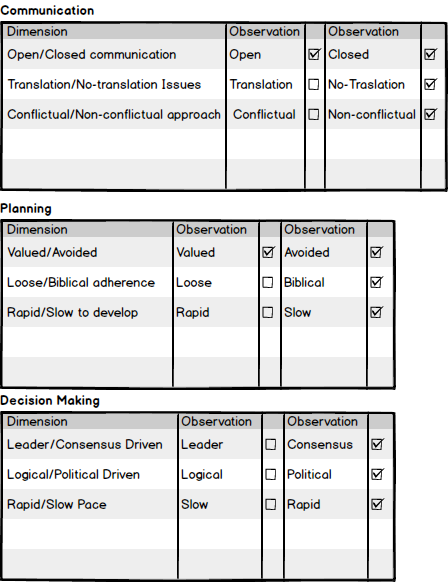
Implementing Product Development Methodologies across Cultures and Organizations After experience at trying to bring various methodologies and ways of approaching product development to different types of organizations in different countries, and often not succeeding as well as I would like, I thought I would attempt at finding some explanations. I currently think of 3 dimensions that are the most important in terms of how they impact a generic methodology or approach. This is not an exhaustive list, however, after much thought these are what I feel are the key contributors to success or failure of putting an effective methodology or approach in place within an organization.  Communication The way that people communicate within the organization or team significantly affects the process of product or service development. Different cultures communicate in different ways, some more "open" others more "closed". Some "hierarchical" others less so. ...

Agile and Lean thinking in Japan

I have just returned from Japan, where I was involved in leading a workshop on Agile and Lean thinking. Being back in the UK, I am reflecting on how things went, what worked and what did not. The whole experience proved to be much more difficult than I could have imagined. Japanese culture does not seem to be compatible with Lean or Agile approaches. Consensus is always needed Time spent on a problem is the primary indicator of effort and success All expressions of ideas need to be well thought out (brainstorming is not natural)  It is natural to delay the commitment of an idea or an approach, so decision making is delayed to the last moment These observations are in total contrast to the Agile or Lean approaches, which value "efficient communication", "lists", "brainstorming" and rapid decision making.  This is probably why these Technics have not much of an adoption in the Japanese business world. If I were to revisit this market, in terms...

WebSockets is the way forward

One of the great frustrations of developing any Web based software system is the request driven paradigm that the HTTP protocol demands. The user sends a request and the server responds, based on some further user interaction further requests are sent and responded to.  There are clever ways of circumventing this behaviour, but they have all been rather messy. One big problem is that a request is generated on the client side either in HTML code or in some Javascript and then handed off to a handler on the server, there maybe many such handlers for different types of request. The response is then handled on the client side somewhere. It all get`s rather messy keeping track of where the request responses are handled and maintaining state. It reminds me of the bad old days of BASIC, where the GOTO command caused execution of the program to jump around. As code grew in complexity it became very difficult to track or debug. Developers were always discouraged from using GOTO unless ab...

Client responsive design

We are no longer in control of the devices on which our media and services are being consumed. They are becoming more varied and numerous in their differences. This is not a new problem, we have been faced with this issue for some time. Previous best solutions revolved around detecting the device capabilities at the server side and making intelligent choices to render the appropriate, fit-for-purpose content on the user device. This solution requires constant updating of the server side logic to account for all the new devices, this is a complex activity, prone to error and cannot possibly account for all the possible variations. Most recently there have been changes in the capabilities of most modern devices. (1) They have sufficient computing power to work out how to render their own content (ignoring legacy devices for now) (2) Most modern devices can run client side scripts to interpret data and render this data appropriately (3) We can define all we...

Coming Soon ....

It's all about data ! Bandwidth will become more freely available at lower cost. Mobile Bandwidth will increase also with cost reduction as technology scales (4G, WiMax etc). As this is all happening the Mobile device, Tablet, Laptop, PC and TV are converging. They are currently different devices, however the operating systems (e.g Android) and the user interfaces are going to continue to converge. Cloud (or remote) storage and services will mean that devices are less dependent on physical hardware on-site and almost entirely dependent on the Internet connection and local processor (see for example Dell's USB stick PC , Rasberry Pi or BeagleBone Black ) As the operating systems converge and thus the user experiences, developers will have more incentive to develop frameworks that work across all devices. Already technologies like WebRTC are being developed to allow complete media transfer between browsers on any device. This means file sharing, video, photo's withou...

Things Entrepeneurs should not pay for ...

Following my previous post, here are a few things that I don't think entrepreneurs should pay for. Networking I do not believe that paid networking events are necessary. There are many very good, free networking opportunities, especially in big cities. There are meetups, forums and many avenues to try before one needs to pay for a networking event. It might be worthwhile joining a long term group, but my experience of one-off paid events has always been a poor one.     Pitching You should never pay to learn how to pitch, there is a world of information, examples and resources for free out there. You should use your family and friends as soundboards for your pitches. There is absolutely no reason to pay to learn how to pitch.   For that matter, I don't believe you should have to pay to pitch to investors (for example). Investors struggle more to find good opportunties than entrepreneurs struggle to find investment. As an entrepreneur you need to target the right...

Selling the Entrepreneurial Dream is not productive

There is a growing industry of consultants, incubators, accelerators, books and courses centered around the "dream" of being a successful entrepreneur. The reality is that most of the individuals or organizations making money in this space are useless. This is a sector of the economy that is unproductive and for the most part does not add economic value.  The resources that any country has can be put to use in a number of ways. If these resources are applied in a productive manner, economic growth will ensue. However, misapplying these resources can generate no growth or contraction for the economy. In a situation where young graduates are encouraged to innovate, to become entrepreneurs without the proper support, this is an un-productive use of resources.  These graduates might be better used in an existing organization (be it at a reduced rate of pay). Fueling this misappropriation of resources are a host of organizations, who make their livelihood by selling a dream, ...